// research
The best day of the week to buy Bitcoin: a DCA backtest
Barely. Buying 25 USDT of BTC every week for 351 weeks, the best weekday (Monday) ended 2.08 percentage points ahead of the worst (Wednesday) on a +170% result; on ETH the gap was 3.42 points. Year by year the winner kept changing.
2 min read

Setup
- Rule: 25 USDT of BTC or ETH every week, always on the same weekday, at that day's daily close (00:00 UTC of the next day), held to the end. One strategy per weekday — seven in all.
- Period: 2020-01-06 → 2026-09-27, Monday to Sunday, exactly 351 weeks, so every weekday gets the same 351 buys. For each calendar year, a 52-week window from its first Monday.
- Market and costs: Binance spot, daily candles, 0.1% fee and 0.05% slippage per buy and sell, 10,000 USDT account — 8,775 USDT of it invested over the period, the rest idle.
- Runs: 98 — 7 weekdays × 2 coins × (the whole period + 6 years). Nothing was tuned.
The whole period

On BTC every weekday finished between +168.22% (Wednesday) and +170.30% (Monday); on ETH between +138.85% (Saturday) and +142.27% (Monday). Spread over 351 weeks, the few days between two possible buys average out.

Monday came first on both coins — by 2.08 points over the worst day on BTC and 3.42 on ETH.
Backtest
DCA every Monday, 25 USDTBTCUSDT · 1d · Spot · 2020-01-06 → 2026-09-27
- Return
- +170.30%
- Max drawdown
- 50.22%
- Sharpe
- 0.62
- Win rate
- 82.6%
- Trades
- 351
Backtest
DCA every Wednesday, 25 USDTBTCUSDT · 1d · Spot · 2020-01-06 → 2026-09-27
- Return
- +168.22%
- Max drawdown
- 50.18%
- Sharpe
- 0.61
- Win rate
- 82.6%
- Trades
- 351
Year by year
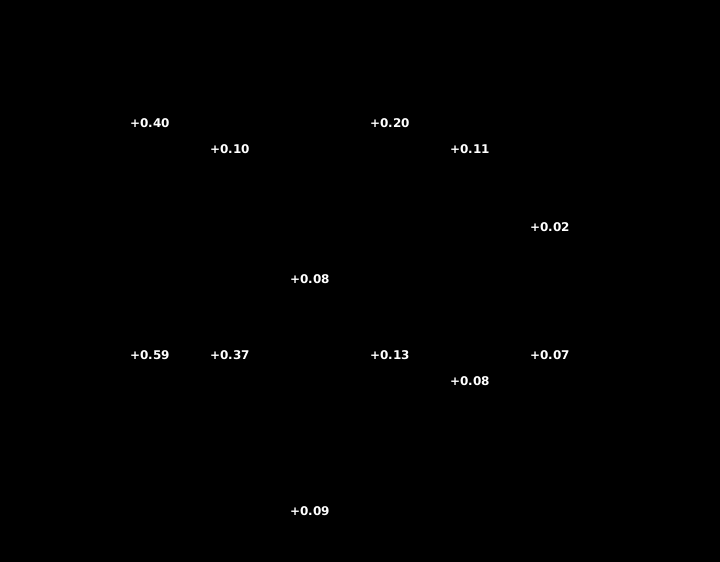
No weekday won every year. On BTC the winner went Monday, Tuesday, Sunday, Monday, Tuesday, Friday; on ETH Monday won four of the six. Inside a year the best weekday was at most 0.59 points above the average one.
All seven days, the whole period
Each return links to its run. 351 buys of 25 USDT per run.
Conclusion
- The day of the week you buy on changed a 351-week DCA result by 2–3 percentage points — far less than the choice of coin, period or amount.
- Monday led on both coins over the whole period, but it did not win every year, and the gaps inside a year were fractions of a point.
- On this evidence the weekday is a detail of a DCA plan, not a lever.
More research: DCA or lump sum.
Test your own idea
Create a free account, start from a template or from your own rules, and read your first report.
More articles
- Does high funding predict crypto crashes? 8 coins, 2020–2026BIS economists found that high crypto carry predicts crashes. On 8 Binance perpetuals, 2020–2026, crashes came more often — but after bigger gains.
- Crypto momentum after the paper: a weekly test on 8 coinsLiu and Tsyvinski found weekly momentum in bitcoin up to 2018. On 8 coins in 2020–2026 the one-week signal lost to holding; four weeks cut drawdowns.
- Does price move the hour before funding? 8 coins, 2020–2026Do traders sell before paying funding? The hour before each settlement on 8 Binance perpetuals, 2020–2026: no reliable move, and fees took what was left.
- Bitcoin after the halving: 2020 and 2024 backtestedDid buying BTC at the halving pay? A year after 2020: +554.04%, top 2.5% of start days. After 2024: +30.45%, below the median. Two cases, no pattern.
- Weekends and time of day: when does bitcoin move?Do bitcoin gains come on weekends or outside US trading hours? Hourly BTC and ETH data since 2020, and session backtests: with fees, -99.87%.